

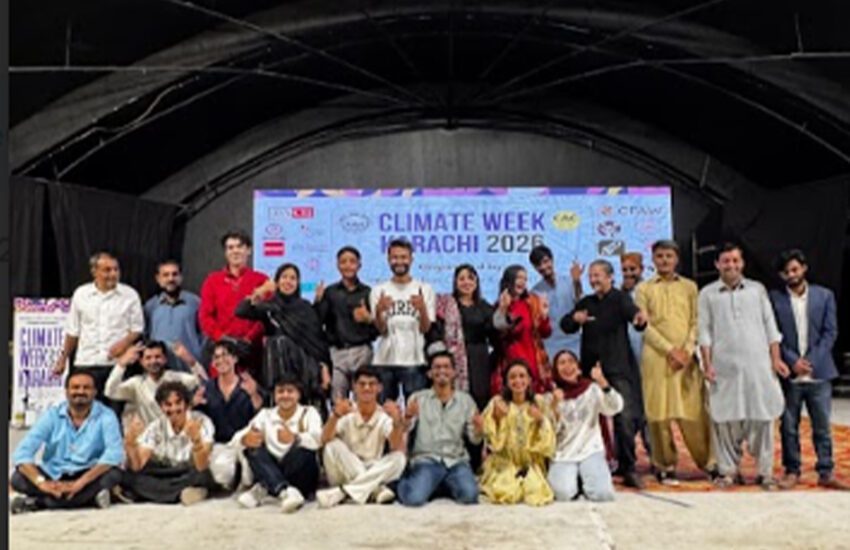
Pakistan’s First-Ever Citywide Climate Week Karachi 2026
Karachi | February 2026 — Climate Week Karachi (CWK) 2026, Pakistan’s first-ever citywide climate week, successfully concluded after a week of powerful conversations, artistic interventions, public engagement, and collective reflection on Karachi’s climate future. Organised by the Climate Action Center Karachi, CWK 2026 was held from 29 January to 4 February 2026, activating the city’s cultural, academic, civic, coastal, and public spaces through a unifying ecological and civilisational lens: the River Indus.
Under the theme “Tides of Tomorrow: City, Memory, Future,” Climate Week Karachi brought together artists, poets, climate activists, riverine and coastal communities, scientists, historians, researchers, policymakers, students, civil society organisations, government representatives, and citizens to collectively reimagine Karachi’s relationship with land, water, energy, memory, and survival.
At the heart of Climate Week Karachi 2026 was the River Indus — not only Pakistan’s primary river system, but a living archive of the region’s history, labour, culture, ecological memory, and collective future. Stretching from the glaciers of the north to its fragile delta at the Arabian Sea, the Indus shaped the central conversations of the week, reminding participants that water is not merely a natural resource, but a living narrative that connects land, livelihoods, communities, histories, and survival.
Karachi, located at the river’s deltaic edge, carries the cumulative consequences of climate change, upstream extraction, sea-level rise, salinity intrusion, ecological collapse, extreme heat, water insecurity, air pollution, and energy crises. Through exhibitions, dialogues, screenings, workshops, performances, and policy conversations, Climate Week Karachi reframed the Indus not as an abstract water system, but as a living entity, a shared inheritance, and a barometer of environmental injustice.
Throughout the week, CWK 2026 foregrounded the interconnected ecologies of water, land, labour, memory, livelihood, health, and climate justice. The programming created space for scientific knowledge to meet cultural practice, for data to transform into stories, and for people’s everyday experiences to become part of a larger environmental and civic narrative.
A central focus of Climate Week Karachi 2026 was the city’s energy future. Sessions and discussions highlighted how dependence on fossil fuels has degraded air, water, and land while deepening social and economic inequalities in urban Pakistan. CWK brought energy justice to the forefront by calling attention to the urgent need for a transition from fossil-based systems toward green, clean, affordable, and renewable energy.
Climate Week Karachi emphasised that the energy transition is not merely a technological shift, but a social and cultural transformation deeply connected to labour, public health, urban air, livelihoods, and climate justice. By linking renewable energy and electric mobility to the River Indus, the coastline, and Karachi’s layered histories, CWK raised a fundamental question: What kind of energy will illuminate our future — and at whose cost?
The week also positioned Karachi not as a passive victim of climate change, but as a space of imagination, resistance, and collective action. By bringing together diverse voices and institutions across the city, Climate Week Karachi 2026 built bridges between knowledge systems, amplified lived experiences, and mobilised a broader public toward just and climate-resilient urban futures.
Speaking at the conclusion of the week, the Climate Action Center Karachi emphasised that CWK 2026 is not the end of a conversation, but the beginning of a long-term public climate movement. The week demonstrated that climate action must move beyond closed rooms and technical discussions, and must enter the spaces where people live, learn, work, create, struggle, and imagine their futures.
Climate Week Karachi 2026 has opened a new chapter in Pakistan’s climate movement by placing the city, the river, and its people at the centre of climate discourse. As Karachi continues to face rising temperatures, water stress, energy insecurity, coastal vulnerability, and public health challenges, CWK has called for urgent, inclusive, and justice-centred climate action rooted in both science and lived experience.
