

Climate Governance
Strengthening Climate Governance: Two-Day Workshop Trains Public Sector for Climate Action.
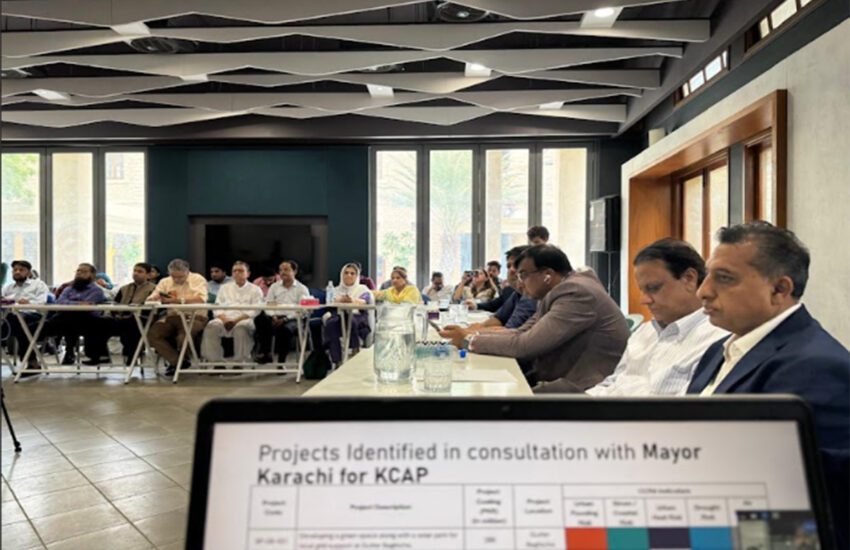
Karachi, June 25, 2025 — The Climate Action Center (CAC), in collaboration with the P&D Research and Training Wing, successfully held a two-day workshop on “Climate-Responsive Governance: Empowering the Public Sector for Climate Action” on June 24–25, 2025, at NED University of Engineering and Technology, City Campus, Karachi. The workshop aimed to build the capacity of government officials to integrate climate priorities into planning and policy, in line with the Karachi Climate Action Plan (KCAP).
Gathering key actors from government departments, academia, civil society, and grassroots organizations, the workshop centered on six critical themes: legal frameworks, digital data infrastructure, energy transition, waste and sanitation, biodiversity, and climate finance.
The first day focused on understanding Karachi’s climate landscape and aligning institutional priorities with KCAP goals.
Abdul Nabi Memon DG from the Research & Training Wing, Planning & Development Government of Sindh, emphasized that Karachi’s urban complexity and climate vulnerabilities demand proactive, informed public sector leadership.
In the keynote session, Yasir Darya, Director CAC introduced the Karachi Climate Action Plan, outlining its vision, key sectors, and implementation status. He stressed the need for interdepartmental alignment and inclusion of local realities into climate strategies.
“CAC works to push change forward, the goal is to simplify even the most technical things so they’re easier to understand, that way, we can reach as many people as possible and create awareness.”
The first thematic session, led by legal expert Zubair Abro Advocate Supreme Court, and Green Chamber CAC, unpacked international climate frameworks and Pakistan’s commitments under the Paris Agreement and Nationally Determined Contributions (NDCs). He explored how these global instruments can inform provincial legislation and action.
This was followed by an engagement with Hafeez Baloch from the Sindh Indigenous Rights Alliance (SIRA), who emphasized that climate justice must include indigenous voices and knowledge systems.
During the Data & Cities session, Yasir Darya, who made a case for developing real-time, publicly accessible climate data systems in Karachi, opened the session by asserting that, “If you focus on climate change issues, the number one priority is data.”
He introduced several pioneering tools and databases that are reshaping how cities like Karachi can be analysed, planned, and made livable. Among them were the Air Quality Life Index (AQLI) developed by the University of Chicago, which offers data for any city of the world, LinkedThings, IQ Air and Air Gradient.
Yasir Darya proposed an integrated model database that links cross-sectoral data, from environmental quality to public health to infrastructure, offering a holistic picture for city planners and policymakers. He advocated for open access to such systems, adding, “We are not focusing on the right metrics when we assess city livability; our analysis is based on out-of-date data.”
The discussion was joined by Dr. Ishaque Ansari from the Sindh Bureau of Statistics, who acknowledged that while their data, including 50 years of archived records, is now digitized and available for researchers, there is no formal department for integrated data in Sindh.
“In Sindh, there is no department for integrated data,” Dr. Ansari stated. “Different departments work in isolation, and data isn’t being shared or aligned.” He noted that although the P&D Department has recently started integrating data, there’s still a long way to go for real-time environmental and disaster-related data. “There is no research on earthquakes in Malir,” he remarked, citing the gaps in geophysical data despite growing risks.
The session closed with a forward-looking conversation on smart cities, the importance of AI-driven early warning systems, and the potential for Pakistan to build cloud-based, cross-sectoral databases that could enable truly climate-responsive governance.
The day closed with a panel discussion on “Energy Transition in Transport & Electricity,” moderated by Yasir Darya. Panelists included, Abubakar Ismail, energy expert, Bilal Hussain, Head of Digital, Business Recorder, Saeed Uddin Ahmed, Associate Professor, NED University, Sachal Wadho, Bahar Foundation, Ali Raza, Head of Strategy & Growth, E-turbo.
Panelists emphasized the importance of aligning technological innovation with community inclusion and infrastructure readiness.
AbuBakar Ismail, energy expert, opened the session by explaining the essence of energy transition. As societies progressed, he noted, energy demand increases, and so does carbon emissions from traditional sources like coal. “We need alternatives that do not harm the environment,” he said, emphasizing the global and local frameworks, such as NEPRA regulations, that are pushing this shift forward.
He also stressed the need for energy equity, explaining how emissions in the formal sector are now subject to global checks like carbon taxes. “Industries need incentives to move faster toward clean energy,” he said, adding that Pakistan’s current subsidy structures often benefit those already connected to power, leaving the underserved behind.
Journalist Bilal Hussain commented on the commercial side of the transition, arguing that without strong regulation, private sector involvement will remain profit-driven. He pointed out that companies entering Pakistan’s electric vehicle market are motivated by bottom-line gains, and raised concern for struggling microloan-based traders in the absence of supportive financial mechanisms.
Sachal Wadho, representing a grassroots perspective, highlighted the inequitable distribution of electricity in underserved areas.
Continuing the discussion, Saeed Uddin Ahmed, urban planner and professor at NED University, addressed the transport-planning disconnect in Karachi. He explained how the distance between residential areas and job zones is growing, increasing reliance on transportation. “Transportation is directly linked to land use,” he said. He pointed out that while formal systems like BRT cover only 1–1.5% of demand, rickshaws and banned chinchis meet nearly 35%, highlighting the importance of integrating these into future transport planning.
Ali Raza from E-Turbo critiqued Pakistan’s historic dependence on imported vehicles and extractive models, but shared that local EV manufacturers are now achieving up to 70% localization.
The day 1 sessions collectively highlighted the importance of integrating policy, law, technology, and local knowledge to create a climate-ready Karachi.
Throughout the day 1, participants also had the opportunity to experience a live test ride of electric vehicles arranged by E-Turbo.
Day Two opened with a powerful session on climate finance pathways by Imtiaz Bhatti, Director General Directorate of Urban & Regional Policy and Strategic Planning, discussing how governments can access green finance to convert climate goals into actionable, community-level infrastructure projects emphasizing the urgent need for innovative funding to support urban climate action. He highlighted Pakistan’s infrastructure investment gap of $10–15 billion annually and stressed, “We are not able to finance regular infrastructure, how can we finance green infrastructure?” Dr. Bhatti introduced tools like green bonds, carbon credits, and climate taxes, and urged the creation of “inter-agency climate financing cells” to mobilize resources. He called for improved fiscal decentralization, tapping into global funds, and ensuring that “whoever pollutes should pay.”
This was followed by a powerful session on waste, sanitation, and public health, with Saeed Uddin Ahmed, Associate Professor, NED University of Engineering and Technology, who explained the intersection of waste management and drainage systems, public health in Karachi, and identified innovative, decentralized, and climate-resilient sanitation strategies.
Later on, the screening of a trailer for “Rehri Goth: The Unseen Chapters” a documentary prepared by Shifa and Maira Pasha of Karachi university, grounded the conversation in local realities, showcasing how poor waste management disproportionately affects Karachi’s marginalized communities, Almas from Mahigeer Samaji Sangat, Yasir Darya, and Saeed Uddin Ahmed also joined the discussion.
A panel on biodiversity and ecosystem resilience emphasized planning with nature. Moderated by Oonib Azam (The Citizenry), Salman Baloch, Biodiversity Expert, Almas, Jawad Khan, Co-founder Climate Resilience Foundation, and Yasir Darya joined the panel to discuss how green infrastructure and community-based conservation can strengthen urban climate resilience.
In later sessions, Hasan Ilyas, Environmental Specialist, Urban Unit Punjab, provided an overview of KCAP progress, and Zarak Khan, Deputy Director, State Bank of Pakistan introduced the concept of green taxonomy, underscoring its relevance in mainstreaming climate finance.
The session traced the State Bank of Pakistan’s evolving journey toward sustainable finance, emphasizing how climate change is no longer treated as a siloed issue, but rather as a strategic, cross-cutting theme embedded across all operations.
The event closed with a thank-you note from Kinza Naseem (Manager Green Energy), and Warda Mumtaz (Researcher City Planning), reaffirming CAC’s commitment to building institutional capacity and cross-sectoral collaboration for a just climate transition.
