

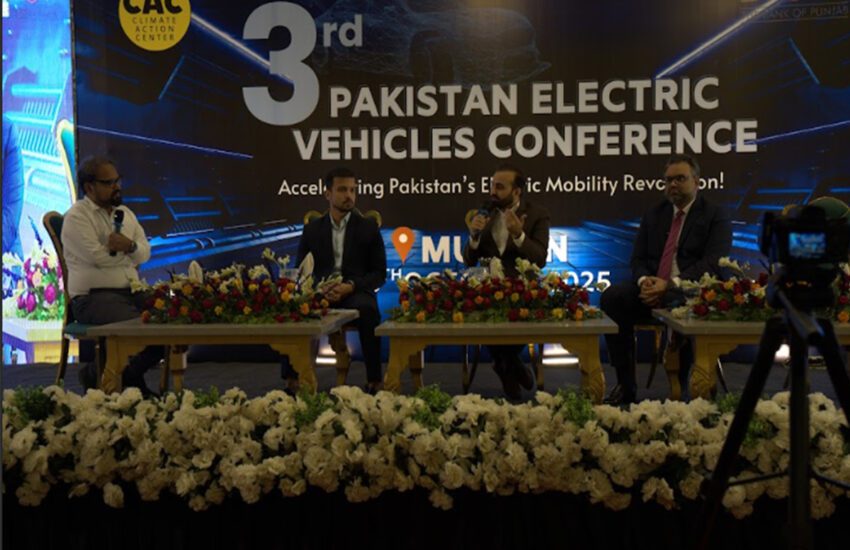
3rd EV Conference
1 Uneven Road Ahead, But the Future Is Electric Vehicles: Stakeholders Concur at Climate Action Center’s 3rd EV Conference in Multan
Multan: The Climate Action Center (CAC) successfully organized the third edition of its Electric Vehicles (EV) Conference in Multan, following the success of its earlier editions in Karachi and Lahore.
The event, sponsored by the Bank of Punjab (BoP) and supported by Horwin, a prominent EV bike manufacturer, brought togethe.r key stakeholders from industry, banking, government, and academia to discuss the country’s transition toward cleaner mobility.
The conference served as a platform for collaboration, emphasizing that a sustainable EV transition in Pakistan requires joint efforts — from policymakers designing incentives, to banks offering financing, and from manufacturers innovating technologies to civil society raising awareness.
Setting the tone for the conference, CAC Director Yasir Husain said the event reflected a growing recognition that electric mobility is no longer a distant dream.
“CAC Karachi is very happy to be in Multan and talking about air quality and EVs at the same time.”
“Things are moving in the right direction and the government has started taking the EV transition seriously,” Husain said.
“The new electric vehicle policy will phase out all petrol-diesel vehicles, cars and bikes, cleaning up air which keeps us sick all the time and causes early deaths. Smog kills.”
“We must facilitate setting up battery recycling units now.”
In his detailed presentation, Naeem Javid, Head of Project Finance and Equity Advisory at the Bank of Punjab, shed light on global and local EV market trends, highlighting both progress and challenges. “EVs are rapidly becoming a mainstream source of mobility across the world,” he said, noting that China alone accounts for 65% of the global EV market. He added that in 2024, 17 million passenger EVs were sold globally, making up 24% of total car sales, and the number is expected to rise to 20 million next year.
Referring to Pakistan’s New EV Policy (2025–2030), Javid said it offers significant tax incentives including a 1% GST on EVs compared to 17% for internal combustion engine (ICE) vehicles, and a 1% import duty on parts, with a PKR 100 billion subsidy over five years for two- and three-wheelers. “The EV market in Pakistan looks promising, but cost and financing remain major hurdles. Long-term, cost-efficient financing will be crucial to make EV ownership affordable,” he emphasized.
The first panel discussion featured Horwin’s General Manager Nauman Alvi, Capital Smart Motors’ Furrukh Raza, BoP’s Naeem Javid, and Nexcells’ CEO Jamshed Iqbal. The discussion explored the opportunities and obstacles in Pakistan’s nascent EV industry, from two-wheelers and four-wheelers to public transport.
Panelists agreed that while global EV adoption is surging due to government support and subsidies, Pakistan faces structural challenges. Javid pointed out that the State Bank of Pakistan (SBP) currently treats EVs the same as ICE vehicles for financing, which has restricted growth.
“We are in continuous discussions to remove these restrictions in line with the national EV policy — a step that will significantly boost adoption,” he said.
Alvi drew attention to Pakistan’s dependence on imported fuel, noting that “we import around $15 billion worth of fuel, 60–70% of which is consumed by two- and three-wheelers.” He added that electrifying this segment should be a top priority. “Two- and three-wheelers contribute up to 80% of traffic emissions and pollution. Their electrification will not only reduce the import bill but also improve urban air quality,” he said.
He also stressed the need for standardization across the EV ecosystem. “Every company, from Tesla to local players, has its own patents for batteries and charging systems. This lack of uniformity hinders scalability. We need a synchronized effort between government departments and industry to create standardized protocols for chargers and battery systems,” Alvi remarked.
Farrukh Raza from Capital Smart Motors said the company is committed to building consumer trust in EVs. “When we entered this business, skepticism was our biggest challenge. We wanted to change the narrative by offering choice — that’s why we became Pakistan’s first multi-brand EV store,” he shared. Raza added that CSM has launched six electric vehicle models and partnered with international automakers like Geely Auto, which ranks among the world’s top EV producers.
Meanwhile, Jamshed Iqbal of Nexcell highlighted the battery quality issue plaguing Pakistan’s EV market. “Many of the imported electric bikes use graphene lead-acid batteries, which have a short life cycle of just 500 cycles. These batteries last only 16–18 months, leading to consumer dissatisfaction. The country needs proper battery standards and quality assurance to sustain EV growth,” he warned.
The second panel, moderated by Maira Mumtaz from CAC, focused on inclusivity and accessibility — exploring how EVs can empower women, lower-income groups, and improve Pakistan’s electricity landscape.
Okla Pakistan’s Vice President sales Muhammad Saeed Akhter shared that “Okla (globally) has achieved over 3 million two-wheeler EV sales since last year,” adding that price remains the biggest factor influencing consumer adoption. “A basic two-wheeler EV costs between Rs150,000 to Rs200,000, and we expect over 116,000 units to be sold nationwide this year,” he said. Akhter added that EVs are gaining traction among women, with 80% of scooty users being female.
Shahzaib Ahmed emphasized that localizing EV products could open up new employment opportunities and called for policies regulating what components are imported and from where. “There should be approved battery suppliers for Pakistan to avoid substandard imports,” he said.
Muhammad Yasin, from Punjab mass transit authority highlighted the progress in public transport electrification, mentioning that 69 EV buses are already operational in Multan. “EV buses like the metro system save time and are environmentally friendly, but we urgently need charging infrastructure to support them,” he noted.
Academic and energy expert Dr. Khalid Waleed from SDPI concluded by stressing that Pakistan’s EV future must balance the “three Es — Economy, Energy, and Environment.” He said, “EV charging infrastructure should be powered by renewables so that it doesn’t harm the environment we’re trying to protect. EVs should be a necessity, not a luxury, and public transport is the right place to begin.”
Summarizing the day’s discussions, CAC’s Hussain Rizvi and Javeria, who hosted the conference, said the Multan conference marks another milestone in building momentum for electric mobility across Pakistan. “The journey is uneven, but the direction is clear — the future of transport is electric. Through collaboration and persistence, we can make that future sustainable and inclusive,” they concluded.
