

Imagining Life
Climate Action Center Launches Imagining Life in Collaboration with NAPA: A Landmark Initiative Merging Climate, Art, and Collective Futures
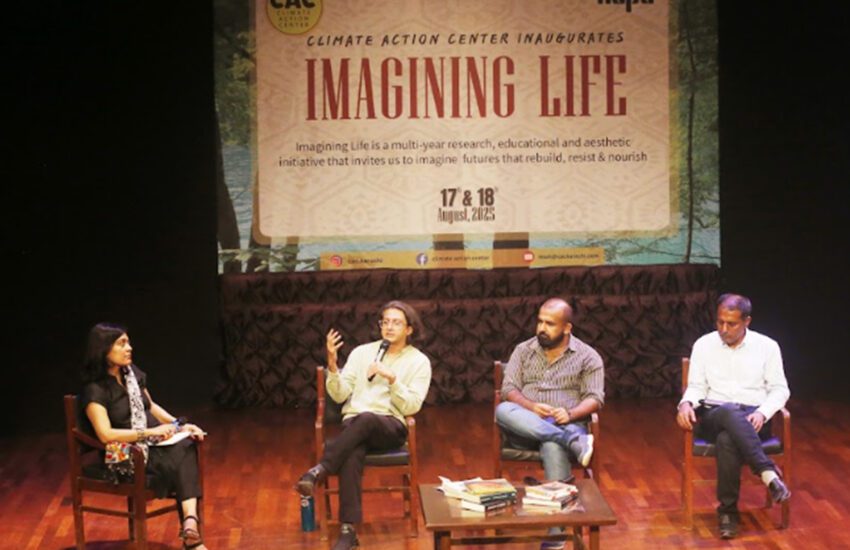
KARACHI, August 18, 2025 — The Climate Action Center (CAC) and Professor Sadia Abbas of Rutgers University, in collaboration with the National Academy of Performing Arts (NAPA), successfully launched Imagining Life — a multiyear, multilingual, and multidisciplinary program that reimagines human futures in the face of climate and planetary crises. The two-day inauguration, held on August 17–18 at NAPA in Karachi, brought together scholars, artists, activists, and community members in a vibrant exchange that blended intellectual rigor with artistic expression.
The launch is part of CAC’s flagship initiative, Climate Narratives, which frames the climate crisis as not only an environmental emergency but also a cultural one. Through storytelling, art, education, and dialogue, Climate Narratives seeks to transform how societies understand and respond to ecological disruption.
“A cultural reset on the heels of planetary boundaries, and local environmental wellbeing is what we seek to enable a formidable response.” Yasir Darya stated, “We are ‘Imagining Life’ as it should be in a future we will make, under the initiative.”
Among the most celebrated moments of the first day was the special screening of Indus Echoes, directed by Rahul Aijaz which — the first Sindhi-language feature film in nearly three decades, presented in collaboration with Anthem Films, which will have its nationwide theatrical release on September 12, 2025, premiering at Cinepax and Neuplex cinemas across Pakistan.
Rooted in the river’s relationship with people’s lives, the film reflected how art can anchor ecological consciousness in cultural memory. “Indus Echoes is now part of the Imagining Life program by CAC, and there couldn’t be a better platform to partner up with,” Aijaz reflected. “Our ideologies and approach toward the climate crisis are very much aligned.” The screening set the stage for deeper conversations that unfolded on the second day.
The intellectual heart of the launch emerged on Day Two with the release of the Urdu translation of Dipesh Chakrabarty’s landmark book The Climate of History in a Planetary Age.
Dipesh spoke personally about the journey of writing the book and the life experiences that informed it. “It is a great privilege and deeply moving for me to see this book translated into Urdu, the first full translation in a South Asian language spoken across India, Pakistan, and Bangladesh. For me, this gesture is more valuable than a big prize, because it represents an act of friendship beyond the boundaries of nation-states.” He added
Javeria Faiz shared the words of translator Ali Siddiqui, who was unable to attend in person, bringing his reflections of the translation process to the audience.
The book’s discussion panel brought together Tariq bin Azad (reviewer), Javeria Faiz (reader of the translators message), and Yasir Darya (director Climate Action Center), along with the author himself joining in conversation, unfortunately Ali Siddiqui (translator) was not able to join in person.
Tariq bin Azad, reflected on his experience as a reviewer of the translation, before reading an excerpt from the translated version of the book. He spoke about the importance of translation as a process, not only in making ideas accessible but also in ensuring that meaning is carefully retained across languages.
Director CAC Yasir stated while expressing his thoughts, “We are elated to publish Dipesh’s book into Urdu, in order to absorb its insights as a stimulus for our own collective mainstream public thinking.”
Sadia Abbas while giving her speech stated, “We translated this book to make this knowledge accessible for all. It is a fantastic book and everyone should have access to it. This is an intellectual project — a space where artists can come together and engage in meaningful intellectual conversations,” said Professor Sadia Abbas in her opening remarks. She further shared her dream of creating multilingual spaces: “My biggest dream has been to arrange a conference where everyone speaks their own language and we provide translators — to remove the shame people feel in their native tongue.”
Dipesh described the initiative (imagining life) as “an innovative and pioneering event,” he added, “Imagining Life is a unique instance of climate activism in the sphere of public culture, the likes of which I have not witnessed anywhere else in the subcontinent.”
Climate Action Center’s decision to bring this work into Urdu marked a powerful act of intellectual democratization, widening the reach of critical climate scholarship beyond academic circles and into the public domain of Pakistan.
The panel also extended an invitation to the audience to see themselves as part of this intellectual project, with CAC expressing its commitment to work collectively so that the book may be translated into Sindhi and other languages as well, beginning a wider process of disseminating knowledge across diverse communities.
Reflecting on the wider impact, Niilofur Farrukh noted, “I see the Imagining Life initiative as a vital platform that connects transformative energies, a bridge between local academia and cultural activists and practitioners. It has opened up a much-needed public space for dialogue, where socially informed practices can meet and inspire collective imagination.”
The two days concluded with an open forum titled What Should Imagining Life Do Next?, moderated by Sadia Abbas and featuring Abira Ashfaq (Advocate, Habib University), Hafeez Baloch (Sindh Indigenous Rights Alliance), and Qalandar Memon (Editor, Naked Punch, Forman Christian College). This participatory session invited community voices to help chart the initiative’s future.
With its inauguration complete, CAC announced that Imagining Life will continue as a multi-year research, educational, and creative initiative. Building on the energy sparked during the launch, it will nurture a long-term platform for reimagining climate-conscious futures through art, scholarship, and collective imagination.
